How to Beat Kreo: A Strategic Guide for Dev Tools
Manual quantity takeoffs consume an average of 50% to 80% of a pre-construction team's time, leaving precious little room for strategic cost analysis or ri...
The 80% Efficiency Gap: Why Manual Takeoffs are Killing Your Bidding Velocity
Manual quantity takeoffs consume an average of 50% to 80% of a pre-construction team's time, leaving precious little room for strategic cost analysis or risk assessment. In the high-stakes world of the API economy and digital construction, this bottleneck is no longer sustainable. At The Code Crafters Collective, we’ve spent the last month debating how AI-driven automation is finally disrupting the "Design" space, moving us away from tedious manual clicking toward intelligent, data-driven workflows. Kreo has emerged as a frontrunner in this shift, promising a 10x increase in bidding speed.
Quick Comparison Table
| Feature | Kreo | Autodesk Revit | Archicad |
|---|---|---|---|
| Pricing | From $35/user/month | Subscription-based (Enterprise focus) | Perpetual & Subscription options |
| Ease of Use | High (AI-driven automation) | Steep learning curve | Moderate to High |
| Core Strength | AI Takeoff & Estimating | Full BIM Lifecycle Management | Architectural Design & Visualization |
| Platform | Cloud-native | Desktop-heavy / Cloud hybrid | Desktop-centric |
The AI Advantage: Where Kreo Redefines the Workflow
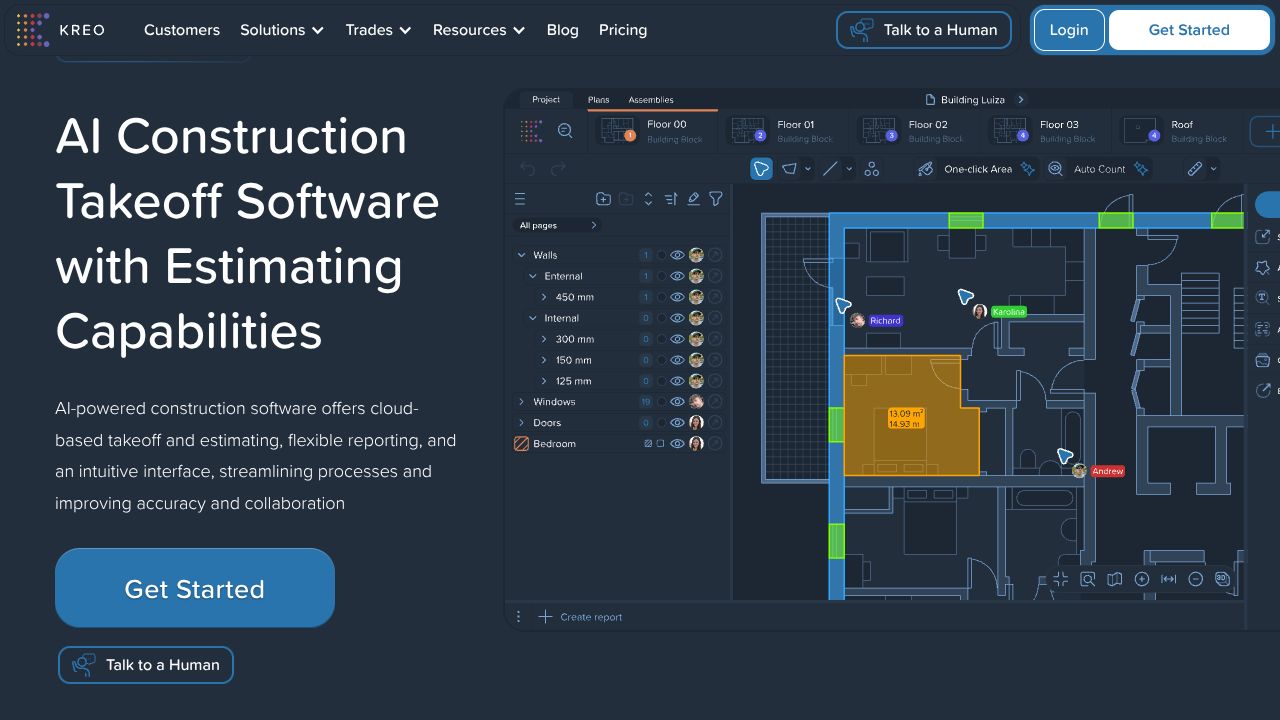
Our team was particularly impressed by how Kreo handles the "messy" reality of construction documentation. While Autodesk Revit is the industry standard for creating complex Building Information Models (BIM), it often requires a high level of expertise to extract usable data for quick bids. Kreo wins here by focusing specifically on the takeoff phase with its "One-Click Area" and "Auto Count" features.
We found three primary areas where Kreo stands out:
- Speed through Automation: Unlike Trimble SysQue, which excels at detailing and fabrication workflows for MEP, Kreo is designed for the rapid-fire pace of the bidding stage. Its AI recognizes patterns in PDFs and CAD files, automating measurements that would take hours in a traditional CAD environment.
- Dynamic Cost Integration: Kreo bridges the gap between a drawing and a Bill of Quantities (BOQ). While Archicad provides incredible tools for architects to document and visualize projects, Kreo’s focus is on the estimator. When you change a measurement in Kreo, the cost plan updates dynamically—a feature our UX designers noted as a major win for reducing cognitive load.
- Low Barrier to Entry: The pricing model (starting at $35/month) makes it accessible for smaller firms. In our collective discussions, we noted that the heavy infrastructure required for Autodesk Revit often prices out boutique contractors who just need fast, accurate quantities.
Where the Legacy Giants Maintain Their Ground
It is important to be realistic: Kreo is a specialized tool. It does not replace the comprehensive design ecosystems of its competitors.
- BIM Depth: If your project requires deep lifecycle management and intricate structural engineering data, Autodesk Revit remains the undisputed king. Kreo is a downstream beneficiary of BIM data, not a replacement for the BIM authoring process.
- MEP Specialization: For those specifically in the mechanical, electrical, and plumbing sectors, Trimble SysQue offers managed content and fabrication-ready detailing that Kreo’s more generalist AI isn't designed to handle.
- Design Aesthetics: Archicad offers a superior environment for architectural visualization and creative documentation. If your goal is "designing" rather than "estimating," Kreo’s interface will feel utilitarian by comparison.
Best Use Cases for Modern Construction Teams
Based on our team's cross-functional review, we recommend choosing your tool based on your primary output:
- Choose Kreo if: You are a quantity surveyor or contractor who needs to turn a stack of 2D PDFs into a priced bid by Friday. Its cloud-native collaboration is perfect for distributed teams.
- Choose Autodesk Revit if: You are managing the entire design-build lifecycle and need a single source of truth for architecture, structure, and MEP.
- Choose Trimble SysQue if: You are a subcontractor focused on MEP fabrication who needs to ensure that models are ready for the shop floor.
- Choose Archicad if: You are an architect-led firm where aesthetic precision and BIM documentation efficiency are the top priorities.
The Verdict
We believe Kreo represents the "API-first" mindset entering the construction space—it’s fast, specialized, and highly collaborative. While it lacks the deep modeling capabilities of Autodesk Revit or the design finesse of Archicad, it solves the "takeoff bottleneck" better than almost anyone else in the market. For pre-construction teams looking to 10x their bidding output without hiring more staff, Kreo is our collective pick for the most practical AI implementation in the design-to-cost category.